
How All-in-One Marketing Automation Platforms Accelerate Business Growth
Summary
An AI powered, all-in-one marketing automation platform is not a campaign tool. It is growth infrastructure. When structured correctly, it unifies CRM, email, social media, reporting, automation logic, and artificial intelligence into a single system that converts engagement into structured intelligence. For founder-led small and mid-sized businesses, that shift reshapes how customers are understood, how sales effort is allocated, and how growth compounds. This is not about sending more messages. It is about building a system that learns faster than your competitors and allocates resources with greater precision.
FAQs
No. Smaller teams benefit disproportionately from structural clarity. When automation is architected correctly, it reduces coordination overhead and replaces reactive effort with predictable systems.
Lock-in is a design problem, not a platform problem. Clean lifecycle definitions, documented workflows, and structured data models preserve independence regardless of vendor.
No. AI accelerates pattern recognition, experimentation, and personalization. Strategic positioning, pricing, and accountability remain human decisions.
No. Email is one channel. The leverage comes from how CRM, behavioral tracking, lifecycle logic, predictive modeling, and experimentation operate as a unified intelligence system.
What an All-in-One Marketing Automation Platform Actually Is
Most businesses approach marketing automation as a productivity upgrade. They want to send emails faster, schedule posts more easily, and generate reports with less manual effort. That framing understates what is actually possible.
An AI powered, all-in-one marketing automation platform is a learning system embedded inside your business. Every interaction a customer has with you—page visits, replies, proposal downloads, pricing reviews, webinar attendance, silence—becomes a structured signal. In fragmented tool stacks, those signals remain disconnected. Website analytics shows behavior without identity. CRM shows pipeline without engagement context. Email tools show opens without revenue correlation. The data exists, but it does not inform decisions in a meaningful way.
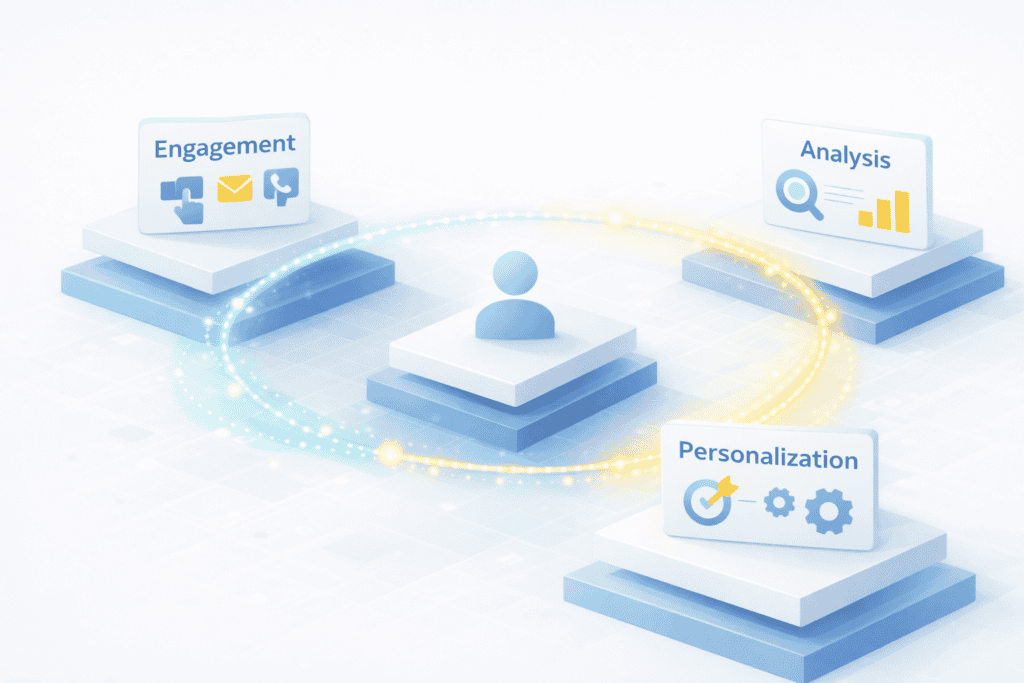
In a unified architecture, engagement compounds. Signals attach to a single identity record. Identity informs segmentation. Segmentation shapes communication logic. Communication generates further engagement. With each cycle, the system becomes more informed. Over time, it begins to recognize patterns that humans alone would struggle to detect consistently.
Artificial intelligence accelerates this compounding loop. Instead of manually reviewing dashboards and inferring intent, the platform identifies behavioral similarity across thousands of interactions. It estimates likelihood to convert, flags churn risk, surfaces high-value clusters, and continuously tests messaging variants. The difference between marketing activity and strategic growth is not volume. It is coherence and disciplined allocation.
Engagement Becomes Structured Intelligence
Engagement is often treated as a performance metric. It is more accurately treated as capital that can either be reinvested or wasted.
A founder-led services firm publishes insights, runs webinars, shares thought leadership, and sends proposals. Prospects browse case studies, revisit pricing pages, forward emails internally, and sometimes disengage entirely. Each behavior reveals intent, hesitation, evaluation patterns, and internal buying dynamics.
In many businesses, that evidence is fragmented. Marketing sees traffic. Sales sees pipeline stages. Leadership sees revenue totals. No one sees the connective narrative that links behavior to outcome.
An all-in-one marketing automation platform consolidates these signals into a unified identity layer. When a contact revisits pricing repeatedly, the system registers rising intent. When they consume implementation documentation, context deepens. When engagement slows, the system surfaces risk before revenue declines. The business no longer waits for deals to stall before recognizing hesitation.
The strategic shift occurs when the conversation moves from “Did this campaign perform?” to “Which behavioral sequences consistently precede revenue?” AI strengthens this shift by clustering contacts based on demonstrated similarity rather than demographic assumption. Patterns that once required months of intuition become visible through structured analysis and repeatable logic.
The campaign is not the asset. The accumulated behavioral intelligence is the asset. Intelligence compounds when the system is designed to remember and when leadership consistently acts on what it reveals.

Why Automation Underperforms
Automation underperforms when layered onto ambiguity. Many companies build sequences incrementally without disciplined lifecycle rules. A welcome sequence is added. A nurture track follows. A re-engagement campaign is layered on top. Over time, triggers overlap, messaging conflicts, and no one remembers the logic that governs the system. The platform becomes operationally busy but strategically thin.
The failure is rarely technical. It is architectural.
Lifecycle definitions must precede automation depth. What behavior qualifies someone as sales-ready? What signals indicate hesitation? What marks a client as at risk? Without disciplined answers, automation accelerates inconsistency and scales confusion.
With structural clarity, automation stabilizes communication. Messaging aligns with demonstrated stage rather than assumption. Sales trusts marketing signals because they are grounded in observable behavior. Reporting gains credibility, and cross-functional friction decreases.
The broader marketing technology landscape has expanded dramatically in recent years, increasing both opportunity and complexity.
More tools do not create advantage. Clear architecture does.
Resource:
- ChiefMartec Marketing Technology Landscape: https://chiefmartec.com/2023/05/marketing-technology-landscape-2023/
Predictive Insight and Smarter Allocation
Static segmentation based on industry or company size remains useful but insufficient. Intent is behavioral, and behavior evolves.
The next step in maturity occurs when businesses move from tracking behavior to predicting outcomes.
AI powered systems cluster contacts according to engagement patterns. Two contacts with identical titles may exhibit entirely different readiness. One consumes thought leadership casually. The other repeatedly engages with pricing and case studies. The system recognizes this distinction without manual tagging and adjusts communication accordingly.
Segmentation becomes fluid rather than fixed. As behavior evolves, segment membership updates automatically. Communication reflects context rather than static attributes. Value articulation aligns with demonstrated interest and likelihood.
Industry analysis increasingly highlights the structural advantage of AI-driven personalization and predictive modeling.
Human intuition is powerful but limited. Sales teams may sense that certain prospects are more likely to convert, but those judgments are difficult to standardize across large pipelines.
AI-enabled marketing automation platforms analyze historical interactions to identify patterns associated with successful deals.
Relevance improves steadily when personalization is informed by behavioral evidence rather than demographic assumption. Over time, this relevance compounds into measurable efficiency gains.
Resources
- Digiday on AI and Personalization Trends: https://digiday.com/marketing/
- The Drum on AI in Marketing: https://www.thedrum.com/topics/ai

Unified Architecture Creates Strategic Clarity
Fragmentation is an invisible tax on growing businesses. CRM in one system, email in another, social scheduling elsewhere, reporting in spreadsheets, AI tools layered externally. Context dissolves across platforms and teams, and insight becomes partial and delayed.
An AI powered, all-in-one marketing automation platform removes this friction by unifying identity, communication, automation logic, and reporting in a shared data structure. Sales sees engagement history. Marketing sees revenue outcomes. Leadership sees probability-weighted pipeline movement. AI operates on complete context rather than fragments.
Platforms such as HubSpot integrate CRM, marketing automation, sales tools, and AI modeling cohesively within a single ecosystem. Zoho offers comparable structural integration with greater pricing flexibility for certain growth stages.
The advantage is not convenience. It is coherence. Coherence improves allocation decisions, and allocation decisions determine long-term growth trajectories.
Resources
- HubSpot AI Overview: https://www.hubspot.com/products/artificial-intelligence
- Zoho Zia AI Overview: https://www.zoho.com/zia/

Continuous Experimentation and Predictive Allocation
Traditional marketing often operates in campaign cycles. A campaign launches, results are measured, lessons are discussed, and the next campaign begins.
AI-enabled marketing automation changes this rhythm.
Experimentation becomes continuous.
Modern platforms can automatically test variations in messaging, subject lines, content formats, and timing. Performance data feeds directly back into the system, allowing stronger variants to receive greater exposure.
Instead of manually reviewing reports once a month, optimization happens constantly.
Personalization also improves dramatically.
When a system understands which topics a prospect reads, which pages they revisit, and which messages they respond to, communication becomes far more relevant.
Financial stakeholders may receive content focused on cost efficiency and ROI. Operational leaders may receive implementation guidance. Technical audiences may receive documentation and product detail.
Each interaction becomes tailored to the signals already observed.
Over time, the system becomes better at understanding how different audiences evaluate solutions.
This learning compounds. Marketing becomes less dependent on intuition and more grounded in structured experimentation.
Resources
- Adweek on AI in Marketing: https://www.adweek.com/category/ai/
- AdAge on Data and Predictive Marketing: https://adage.com/marketing-data
Risk, Governance, and Responsibility
As intelligence increases, responsibility grows.
Marketing automation platforms manage sensitive information about customers and prospects. Data governance, privacy compliance, and security practices become essential foundations.
Businesses must ensure that:
- Data collection is transparent and purposeful
- Access permissions are carefully managed
- Lifecycle definitions remain consistent
- Reporting integrity is maintained
Artificial intelligence can surface anomalies and assist with monitoring, but it cannot replace accountability.
Organizations must remain responsible stewards of the data they collect.
Trust is not only a legal obligation. It is a strategic asset.
AI and Automation
Artificial intelligence is reshaping how marketing automation platforms operate.
Where automation previously executed predefined rules, AI now enhances decision-making across the system.
Examples include:
- Predictive lead scoring
- Automated segmentation based on behavior
- Content generation for personalized messaging
- Intelligent send-time optimization
- Anomaly detection in campaign performance
AI excels at identifying patterns within large datasets and proposing optimizations.
However, human judgment remains essential.
AI can recommend which audience segments are likely to convert, but humans must determine whether those segments align with the company’s strategic positioning.
AI can generate content variations, but humans must ensure that messaging remains accurate and authentic.
Used responsibly, AI expands the analytical capabilities of the organization without replacing strategic thinking.
Operating Philosophy
Digital Captain Co. approaches marketing automation as infrastructure rather than as a campaign tool.
The objective is to build systems that:
- Unify customer data
- Align marketing and sales activity
- Create clear lifecycle definitions
- Enable continuous experimentation
For many founder-led businesses, HubSpot provides the most cohesive architecture for this purpose. Its CRM, marketing automation, and reporting capabilities operate within a single platform, making it easier to maintain structural clarity.
For organizations prioritizing cost efficiency, Zoho offers a flexible alternative with similar integration capabilities.
The goal is not dependence on any specific vendor. The goal is creating a system that supports learning, clarity, and sustainable growth.
Lifecycle Maturity
Organizations typically evolve through several stages when adopting marketing automation.
Early stages focus on basic email communication and contact management.
Intermediate stages introduce segmentation, behavioral tracking, and automation workflows.
More advanced stages incorporate predictive modeling, lifecycle analysis, and continuous experimentation.
The most mature organizations treat marketing automation not as a tool but as a strategic intelligence layer connecting marketing, sales, and customer success.
At that point, the platform becomes part of the company’s operating system.
Growth as Structured Learning
The term “growth hacking” often suggests shortcuts or clever tactics.
In reality, sustainable growth rarely comes from isolated tricks. It comes from systems that learn faster than competitors.
An AI-powered marketing automation platform accelerates this learning cycle.
Customer engagement generates behavioral signals.
Signals generate insight.
Insight improves targeting and messaging.
Improved messaging produces stronger engagement.
The cycle repeats, becoming more precise with each iteration.
Over time, marketing becomes less reactive and more deliberate. Decisions rely on accumulated evidence rather than anecdotes.
Growth is not hacked.
It is learned.
And when that learning is embedded into the infrastructure of the business, improvement compounds naturally.
Get a free quote
Summary
An AI powered, all-in-one marketing automation platform is not a campaign tool. It is growth infrastructure. When structured correctly, it unifies CRM, email, social media, reporting, automation logic, and artificial intelligence into a single system that converts engagement into structured intelligence. For founder-led small and mid-sized businesses, that shift reshapes how customers are understood, how sales effort is allocated, and how growth compounds. This is not about sending more messages. It is about building a system that learns faster than your competitors and allocates resources with greater precision.
FAQs
No. Smaller teams benefit disproportionately from structural clarity. When automation is architected correctly, it reduces coordination overhead and replaces reactive effort with predictable systems.
Lock-in is a design problem, not a platform problem. Clean lifecycle definitions, documented workflows, and structured data models preserve independence regardless of vendor.
No. AI accelerates pattern recognition, experimentation, and personalization. Strategic positioning, pricing, and accountability remain human decisions.
No. Email is one channel. The leverage comes from how CRM, behavioral tracking, lifecycle logic, predictive modeling, and experimentation operate as a unified intelligence system.
What an All-in-One Marketing Automation Platform Actually Is
Most businesses approach marketing automation as a productivity upgrade. They want to send emails faster, schedule posts more easily, and generate reports with less manual effort. That framing understates what is actually possible.
An AI powered, all-in-one marketing automation platform is a learning system embedded inside your business. Every interaction a customer has with you—page visits, replies, proposal downloads, pricing reviews, webinar attendance, silence—becomes a structured signal. In fragmented tool stacks, those signals remain disconnected. Website analytics shows behavior without identity. CRM shows pipeline without engagement context. Email tools show opens without revenue correlation. The data exists, but it does not inform decisions in a meaningful way.
In a unified architecture, engagement compounds. Signals attach to a single identity record. Identity informs segmentation. Segmentation shapes communication logic. Communication generates further engagement. With each cycle, the system becomes more informed. Over time, it begins to recognize patterns that humans alone would struggle to detect consistently.
Artificial intelligence accelerates this compounding loop. Instead of manually reviewing dashboards and inferring intent, the platform identifies behavioral similarity across thousands of interactions. It estimates likelihood to convert, flags churn risk, surfaces high-value clusters, and continuously tests messaging variants. The difference between marketing activity and strategic growth is not volume. It is coherence and disciplined allocation.
Get a free quote
Engagement Becomes Structured Intelligence
Engagement is often treated as a performance metric. It is more accurately treated as capital that can either be reinvested or wasted.
A founder-led services firm publishes insights, runs webinars, shares thought leadership, and sends proposals. Prospects browse case studies, revisit pricing pages, forward emails internally, and sometimes disengage entirely. Each behavior reveals intent, hesitation, evaluation patterns, and internal buying dynamics.
In many businesses, that evidence is fragmented. Marketing sees traffic. Sales sees pipeline stages. Leadership sees revenue totals. No one sees the connective narrative that links behavior to outcome.
An all-in-one marketing automation platform consolidates these signals into a unified identity layer. When a contact revisits pricing repeatedly, the system registers rising intent. When they consume implementation documentation, context deepens. When engagement slows, the system surfaces risk before revenue declines. The business no longer waits for deals to stall before recognizing hesitation.
The strategic shift occurs when the conversation moves from “Did this campaign perform?” to “Which behavioral sequences consistently precede revenue?” AI strengthens this shift by clustering contacts based on demonstrated similarity rather than demographic assumption. Patterns that once required months of intuition become visible through structured analysis and repeatable logic.
The campaign is not the asset. The accumulated behavioral intelligence is the asset. Intelligence compounds when the system is designed to remember and when leadership consistently acts on what it reveals.
Why Automation Underperforms
Automation underperforms when layered onto ambiguity. Many companies build sequences incrementally without disciplined lifecycle rules. A welcome sequence is added. A nurture track follows. A re-engagement campaign is layered on top. Over time, triggers overlap, messaging conflicts, and no one remembers the logic that governs the system. The platform becomes operationally busy but strategically thin.
The failure is rarely technical. It is architectural.
Lifecycle definitions must precede automation depth. What behavior qualifies someone as sales-ready? What signals indicate hesitation? What marks a client as at risk? Without disciplined answers, automation accelerates inconsistency and scales confusion.
With structural clarity, automation stabilizes communication. Messaging aligns with demonstrated stage rather than assumption. Sales trusts marketing signals because they are grounded in observable behavior. Reporting gains credibility, and cross-functional friction decreases.
The broader marketing technology landscape has expanded dramatically in recent years, increasing both opportunity and complexity.
More tools do not create advantage. Clear architecture does.
Resource:
- ChiefMartec Marketing Technology Landscape: https://chiefmartec.com/2023/05/marketing-technology-landscape-2023/
Predictive Insight and Smarter Allocation
Static segmentation based on industry or company size remains useful but insufficient. Intent is behavioral, and behavior evolves.
The next step in maturity occurs when businesses move from tracking behavior to predicting outcomes.
AI powered systems cluster contacts according to engagement patterns. Two contacts with identical titles may exhibit entirely different readiness. One consumes thought leadership casually. The other repeatedly engages with pricing and case studies. The system recognizes this distinction without manual tagging and adjusts communication accordingly.
Segmentation becomes fluid rather than fixed. As behavior evolves, segment membership updates automatically. Communication reflects context rather than static attributes. Value articulation aligns with demonstrated interest and likelihood.
Industry analysis increasingly highlights the structural advantage of AI-driven personalization and predictive modeling.
Human intuition is powerful but limited. Sales teams may sense that certain prospects are more likely to convert, but those judgments are difficult to standardize across large pipelines.
AI-enabled marketing automation platforms analyze historical interactions to identify patterns associated with successful deals.
Relevance improves steadily when personalization is informed by behavioral evidence rather than demographic assumption. Over time, this relevance compounds into measurable efficiency gains.
Resources
- Digiday on AI and Personalization Trends: https://digiday.com/marketing/
- The Drum on AI in Marketing: https://www.thedrum.com/topics/ai
Unified Architecture Creates Strategic Clarity
Fragmentation is an invisible tax on growing businesses. CRM in one system, email in another, social scheduling elsewhere, reporting in spreadsheets, AI tools layered externally. Context dissolves across platforms and teams, and insight becomes partial and delayed.
An AI powered, all-in-one marketing automation platform removes this friction by unifying identity, communication, automation logic, and reporting in a shared data structure. Sales sees engagement history. Marketing sees revenue outcomes. Leadership sees probability-weighted pipeline movement. AI operates on complete context rather than fragments.
Platforms such as HubSpot integrate CRM, marketing automation, sales tools, and AI modeling cohesively within a single ecosystem. Zoho offers comparable structural integration with greater pricing flexibility for certain growth stages.
The advantage is not convenience. It is coherence. Coherence improves allocation decisions, and allocation decisions determine long-term growth trajectories.
Resources
- HubSpot AI Overview: https://www.hubspot.com/products/artificial-intelligence
- Zoho Zia AI Overview: https://www.zoho.com/zia/
Continuous Experimentation and Predictive Allocation
Traditional marketing often operates in campaign cycles. A campaign launches, results are measured, lessons are discussed, and the next campaign begins.
AI-enabled marketing automation changes this rhythm.
Experimentation becomes continuous.
Modern platforms can automatically test variations in messaging, subject lines, content formats, and timing. Performance data feeds directly back into the system, allowing stronger variants to receive greater exposure.
Instead of manually reviewing reports once a month, optimization happens constantly.
Personalization also improves dramatically.
When a system understands which topics a prospect reads, which pages they revisit, and which messages they respond to, communication becomes far more relevant.
Financial stakeholders may receive content focused on cost efficiency and ROI. Operational leaders may receive implementation guidance. Technical audiences may receive documentation and product detail.
Each interaction becomes tailored to the signals already observed.
Over time, the system becomes better at understanding how different audiences evaluate solutions.
This learning compounds. Marketing becomes less dependent on intuition and more grounded in structured experimentation.
Resources
- Adweek on AI in Marketing: https://www.adweek.com/category/ai/
- AdAge on Data and Predictive Marketing: https://adage.com/marketing-data
Risk, Governance, and Responsibility
As intelligence increases, responsibility grows.
Marketing automation platforms manage sensitive information about customers and prospects. Data governance, privacy compliance, and security practices become essential foundations.
Businesses must ensure that:
- Data collection is transparent and purposeful
- Access permissions are carefully managed
- Lifecycle definitions remain consistent
- Reporting integrity is maintained
Artificial intelligence can surface anomalies and assist with monitoring, but it cannot replace accountability.
Organizations must remain responsible stewards of the data they collect.
Trust is not only a legal obligation. It is a strategic asset.
AI and Automation
Artificial intelligence is reshaping how marketing automation platforms operate.
Where automation previously executed predefined rules, AI now enhances decision-making across the system.
Examples include:
- Predictive lead scoring
- Automated segmentation based on behavior
- Content generation for personalized messaging
- Intelligent send-time optimization
- Anomaly detection in campaign performance
AI excels at identifying patterns within large datasets and proposing optimizations.
However, human judgment remains essential.
AI can recommend which audience segments are likely to convert, but humans must determine whether those segments align with the company’s strategic positioning.
AI can generate content variations, but humans must ensure that messaging remains accurate and authentic.
Used responsibly, AI expands the analytical capabilities of the organization without replacing strategic thinking.
Operating Philosophy
Digital Captain Co. approaches marketing automation as infrastructure rather than as a campaign tool.
The objective is to build systems that:
- Unify customer data
- Align marketing and sales activity
- Create clear lifecycle definitions
- Enable continuous experimentation
For many founder-led businesses, HubSpot provides the most cohesive architecture for this purpose. Its CRM, marketing automation, and reporting capabilities operate within a single platform, making it easier to maintain structural clarity.
For organizations prioritizing cost efficiency, Zoho offers a flexible alternative with similar integration capabilities.
The goal is not dependence on any specific vendor. The goal is creating a system that supports learning, clarity, and sustainable growth.
Lifecycle Maturity
Organizations typically evolve through several stages when adopting marketing automation.
Early stages focus on basic email communication and contact management.
Intermediate stages introduce segmentation, behavioral tracking, and automation workflows.
More advanced stages incorporate predictive modeling, lifecycle analysis, and continuous experimentation.
The most mature organizations treat marketing automation not as a tool but as a strategic intelligence layer connecting marketing, sales, and customer success.
At that point, the platform becomes part of the company’s operating system.
Growth as Structured Learning
The term “growth hacking” often suggests shortcuts or clever tactics.
In reality, sustainable growth rarely comes from isolated tricks. It comes from systems that learn faster than competitors.
An AI-powered marketing automation platform accelerates this learning cycle.
Customer engagement generates behavioral signals.
Signals generate insight.
Insight improves targeting and messaging.
Improved messaging produces stronger engagement.
The cycle repeats, becoming more precise with each iteration.
Over time, marketing becomes less reactive and more deliberate. Decisions rely on accumulated evidence rather than anecdotes.
Growth is not hacked.
It is learned.
And when that learning is embedded into the infrastructure of the business, improvement compounds naturally.